

Marketplaces hold 61% of EU ecommerce GMV, but that doesn't mean you should sell everywhere. Use this framework to decide if a marketplace, D2C, or a hybrid strategy converts profitably for your brand. The choice between marketplace listings and your own store is not about which channel is "better"—it's about which channel fits your brand's economics, control needs, and customer journey. Price sensitivity dominates consumer behavior, and conversion mechanics differ sharply by channel. This guide walks you through the data, the decision framework, and the practical steps to test and validate your channel mix before committing resources.
Marketplace Share and What It Means for Your Channel Strategy
In 2025, marketplaces accounted for 61 percent of total ecommerce GMV in Europe [1]. Globally, marketplaces accounted for 83.4 percent of e-commerce GMV [1]. This concentration reflects where shoppers start their product searches and where they complete transactions. The GMV share of marketplaces in Europe grew from 56.2 percent in 2023 to 60.8 percent in 2025 [1]. This upward trajectory signals that marketplaces are capturing an increasing portion of online spending, not just maintaining their position.
Regional differences are stark. In 2025, marketplaces made up 67.8% of ecommerce GMV in the Americas and 97.0% in Asia [1]. Asia's near-total marketplace dominance means brands entering those markets face a structural reality: consumers expect to shop on platforms, not brand sites. For cross-border sellers, the channel decision is even more constrained. About 70% of cross-border ecommerce turnover flows through marketplaces [2]. If your growth plan includes international expansion, marketplaces are not optional—they are the primary infrastructure for reaching buyers in new geographies.
These GMV figures do not tell you where your brand will convert most profitably. They tell you where the volume is and where consumer behavior is already anchored. High marketplace share means high traffic and high competition. It also means shoppers arrive with price-driven intent, not brand loyalty.
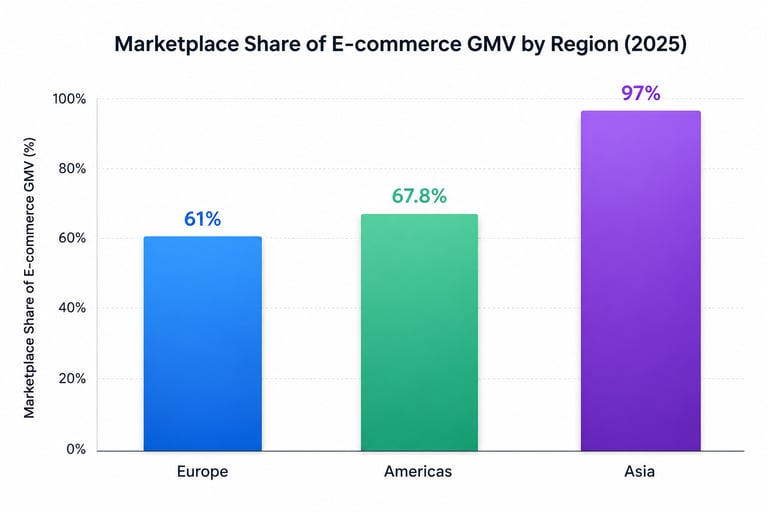
Marketplace GMV share by region: Europe 61%, Americas 67.8%, Asia 97%
Conversion Rates by Channel: What the Data Shows
Median conversion for new visitors on their own Shopify store is 1.0–2.5% [3]. For returning visitors on their own Shopify store, the median conversion is 8–14% [3]. The gap between new and returning visitor conversion is the clearest signal that owned channels reward retention, not acquisition. If you are driving cold traffic to your own site, expect single-digit conversion at best. If you are bringing back customers who already know your brand, conversion jumps significantly.
Marketplace listings convert at about 2.0–4.5% on Shopee and 1.5–3.5% on Lazada [3]. These ranges sit between cold and warm D2C traffic, reflecting the fact that marketplace visitors are already in buying mode but may not know your brand. TikTok Shop conversion is around 0.8–2.2%, while live selling sessions convert 6–18% [3]. Live selling's higher conversion comes from real-time interaction and urgency, not from the platform's baseline mechanics.
In fashion, average D2C sites see ~2–3% conversion vs ~4–7% for marketplaces [4]. This sector-specific data reinforces the pattern: marketplaces convert cold traffic more efficiently than owned sites. The tradeoff is that you lose control over the customer relationship, the checkout experience, and the data.
These conversion ranges are not predictions of your performance. They are benchmarks that show the structural advantage marketplaces have for discovery-driven purchases, and the structural advantage owned sites have for repeat purchases. Your channel decision should align with where your customers are in their journey and how much margin you can afford to give up for higher baseline conversion.
Price Sensitivity and Brand Loyalty Realities
66% of U.S. consumers cite lower prices as a significant shopping factor [5]. This is not a niche behavior—it is the dominant driver for most shoppers. 70% of shoppers prioritized price over brand, while only 10% bought based on brand alone [6]. These figures show that brand equity does not insulate most products from price comparison. If your product is available on a marketplace at a lower price, or if a competitor's similar product is cheaper, most shoppers will choose the lower price.
This price sensitivity has direct implications for channel strategy. Marketplaces amplify price competition because they display multiple sellers side by side. If you sell on Amazon, your listing appears next to competitors, resellers, and potentially unauthorized sellers. Shoppers sort by price, read reviews, and make decisions based on value, not brand story. On your own site, you control the narrative, but you must drive traffic yourself—and that traffic arrives with the same price expectations.
For luxury brands, the calculus is different. If your product relies on brand perception, in-person trial, or high lifetime value from a small customer base, marketplaces may dilute your positioning. For mid-market brands, price sensitivity is the default, and your channel strategy must account for the fact that most shoppers will compare prices before buying.
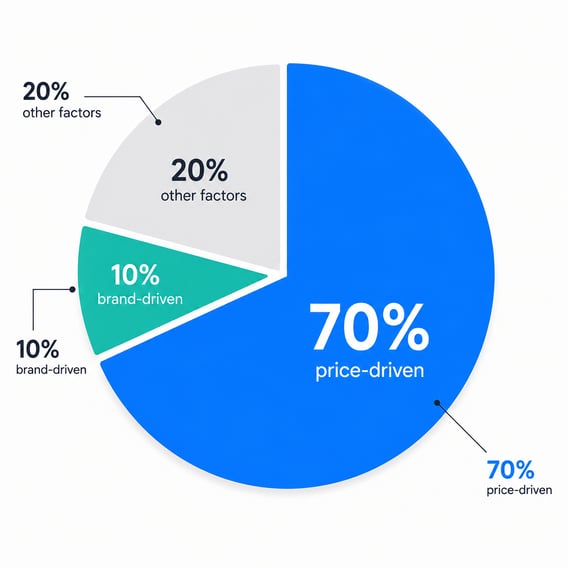
Consumer shopping priorities: 70% prioritize price, 10% buy based on brand alone
Channel Economics: Margin and Fee Structures
Amazon sellers typically pay 15–45% commission on sales [7]. This range depends on category, fulfillment method, and whether you use additional Amazon services. The commission is not the only cost—you also pay for advertising, storage, and potentially brand registry or enhanced content features. One analysis found a net margin of 22–37% on a $45 sale via D2C versus 18–42% on Amazon [7]. The margin overlap shows that neither channel is universally more profitable; the outcome depends on your product cost structure, your ability to drive traffic, and your conversion rate.
On your own site, you avoid marketplace commissions, but you pay for platform fees, payment processing, hosting, and customer acquisition. If your customer acquisition cost is high and your conversion rate is low, your effective margin may be worse than on a marketplace. If you can convert returning customers at high rates and keep acquisition costs reasonable, your own site will deliver better unit economics.
The margin comparison is not static. As you scale on a marketplace, your advertising costs often rise due to increased competition. On your own site, you can build organic traffic, email lists, and repeat purchase loops that reduce your marginal cost of acquisition over time. The right channel depends on your current margin, your ability to acquire customers efficiently, and your timeline for profitability.
Hybrid Strategy: When to Use Both Channels
A hybrid approach uses marketplaces for top-of-funnel discovery and owned channels for retention and higher lifetime value. This strategy makes sense when your product has repeat purchase potential, when your brand can differentiate beyond price, and when you can afford to operate both channels without operational strain. Marketplaces bring traffic you would not otherwise reach. Your own site captures customers who want a direct relationship, exclusive products, or a better post-purchase experience.
The hybrid model requires clear segmentation. You must decide which products to list on marketplaces, which to keep exclusive to your site, and how to handle pricing conflicts. If you sell the same product at different prices across channels, shoppers will notice, and your brand credibility will suffer. If you offer exclusive SKUs or bundles on your own site, you create a reason for customers to buy direct without undercutting your marketplace presence.
Operationally, running both channels means managing inventory sync, customer service across platforms, and separate marketing funnels. Promotional leakage is a common problem: a discount code intended for your email list gets shared on deal forums and used by marketplace shoppers, eroding your margin without building your owned customer base. Multi-store management adds complexity, and platform maintenance costs accumulate. Before committing to a hybrid strategy, validate that you can handle the operational overhead and that the incremental revenue justifies the added cost.
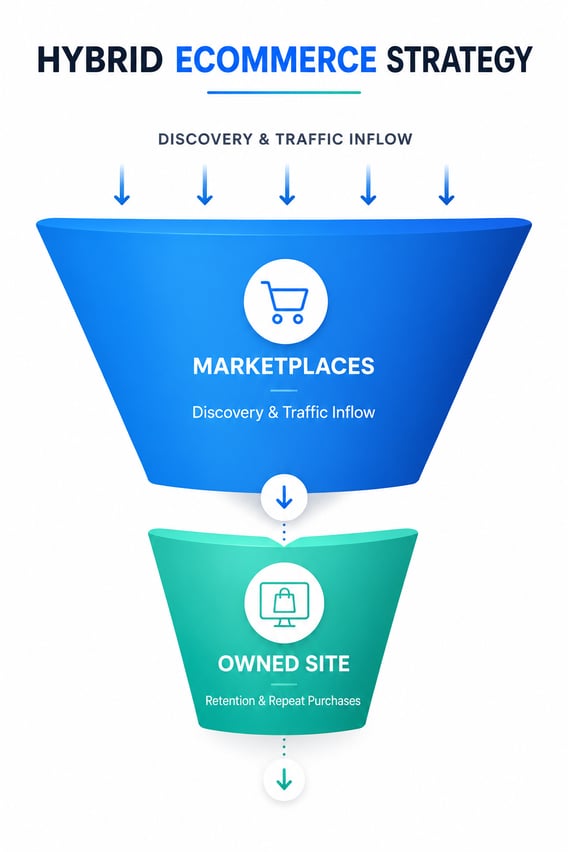
Hybrid funnel: marketplaces for discovery, owned site for retention
Optimizing Marketplace Listings for Conversion
All of your product pages must quickly and clearly state what a product is and why it's valuable [8]. This principle applies to marketplace listings as much as to your own site. Shoppers scan titles, images, and bullet points in seconds. If your listing does not immediately communicate the product's purpose and benefit, they move to the next result.
Treat descriptions as short buying guides that include who the product is for, what problem it solves, and key benefits instead of just features, and make sure to write original descriptions rather than copying manufacturer content [9]. Generic or manufacturer-supplied copy does not differentiate your listing. Shoppers need to know why your product is the right choice for their specific need, not just what it does.
You can add A+ Content to listings to vividly showcase product qualities, your brand's story, and other information that can help inspire customers to click [9]. Enhanced content gives you more space to build trust and explain value. Add dynamic, engaging video content to product detail pages, as shoppable videos show your products in action and provide customers with more details of your product's features and benefits [9]. Video increases engagement and helps shoppers visualize the product in use, which can lift conversion rates. Replace static images with interactive 3D experiences and augmented reality, similar to those provided by Wearitar, to increase user engagement and reduce buyer’s remorse by allowing customers to interact with and experience the product before buying.
Your headline should blend the vital information customers need with motivational wording to encourage them to buy your product [10]. The title is the first thing shoppers see in search results. It must include the product name, key attributes, and a reason to click. Avoid keyword stuffing; focus on clarity and relevance.
- State what the product is and why it's valuable in the title and first bullet point
- Write original descriptions that explain who the product is for and what problem it solves
- Add A+ Content or enhanced brand content to showcase product qualities and brand story
- Include video content that shows the product in action and highlights key benefits
- Blend vital product information with motivational wording in your headline
Optimizing Your Own Site for Conversion
Remove all unnecessary form fields at checkout [11]. Every additional field increases friction and reduces the likelihood that a shopper completes the purchase. Ask only for the information you need to fulfill the order and process payment. Do not request optional data during checkout—collect it post-purchase if necessary.
Help people get more value from their order with upsells and cross-sells [11]. Offer complementary products or upgrades at checkout or immediately after the initial purchase decision. This increases average order value without requiring additional traffic. Make sure the upsell is relevant and does not distract from completing the primary transaction.
According to Amazon Growth Lab, navigation structure makes or breaks your Amazon store strategy, and you should organize by category, use case, or customer persona—never by random product dumps [12]. This same principle applies to your own site. Shoppers need to find products quickly. If your navigation is unclear or your product organization is arbitrary, they will leave. Group products logically, use clear labels, and make sure your search function works.
- Remove all unnecessary form fields from your checkout flow
- Offer relevant upsells and cross-sells to increase order value without adding friction
- Organize site navigation by category, use case, or customer persona
- Ensure your search function returns accurate, relevant results
Testing and Validation Before Full Commitment
Before migrating your entire catalog to a new channel or launching a full hybrid strategy, run small experiments to validate conversion and economics. Start with a subset of SKUs that represent your core product mix. Track conversion rate, customer acquisition cost, average order value, and repeat purchase rate for each channel. Compare these metrics to your baseline performance and to your margin targets.
Set a time-bound test period—long enough to gather statistically meaningful data, but short enough to limit downside if the channel does not perform. For most brands, a test period of one to three months provides enough transaction volume to assess performance. During the test, do not make major changes to pricing, product selection, or marketing tactics. You need clean data to understand the channel's baseline performance.
Measure not just conversion rate, but also customer lifetime value. A channel that converts well but attracts one-time buyers may not be profitable in the long run. A channel that converts poorly but brings in high-LTV customers may justify higher acquisition costs. Your validation framework should account for both immediate conversion and long-term customer value.
If the test shows that a channel is not profitable, do not assume the problem is the channel itself. Examine your listing quality, your pricing, your product-market fit, and your marketing approach. Sometimes the issue is execution, not strategy. If the test confirms that a channel works, scale gradually. Monitor your metrics as you increase spend and inventory. Channels that perform well at a small scale can degrade as competition increases or as you move beyond your core audience.
Conclusion
Your channel strategy should match your brand's margin structure, customer acquisition capability, and control requirements. Marketplaces deliver higher baseline conversion for discovery-driven purchases, but they compress margins and limit your ability to build direct customer relationships. Owned sites reward retention and allow full control over the customer experience, but they require you to drive traffic and convert cold visitors efficiently. A hybrid approach can capture the benefits of both channels if you can manage the operational complexity and avoid pricing conflicts. Test your assumptions with small experiments, measure conversion and lifetime value rigorously, and scale only when the data supports it. Which channel will you validate first?


SUBMIT YOUR COMMENT