

Wrong addresses cost you $300+ orders and trigger chargebacks. These checkout optimization tactics prevent delivery failures and protect high-ticket conversions. E-commerce merchants face significant losses from payment fraud and delivery failures. For brands selling high-ticket items, each failed delivery represents a substantial margin loss and potential dispute. Implementing targeted checkout and operational controls can materially reduce these failure rates while protecting conversion.
The Cost of Address Errors on High-Value Transactions
Retailers lose 3.6% of their e-commerce revenue to payment fraud, according to ECR Retail Loss data [1]. This revenue leakage includes both fraudulent transactions and legitimate orders that fail due to preventable errors. About 3.1% of all online orders become chargebacks [1]. When an order exceeds several hundred dollars, a single chargeback can eliminate the margin from multiple successful transactions.
Delivery failures amplify these losses. About 5% of online orders are not delivered on the first attempt [2]. In the UK, about 5.6% of online orders fail to arrive at first attempt, costing approximately 16.4 euros per failed delivery [2]. For high-ticket products, the cost per failed delivery is substantially higher when you account for product value, return shipping, customer service time, and the risk of damage or loss during re-delivery attempts.
The previously cited 3.1% chargeback rate also highlights the dispute risk inherent in delivery failures. When a customer does not receive an order due to an incorrect address, they often initiate a chargeback rather than contacting the merchant. This creates a dual loss: the product cost and the chargeback fee. For orders above a certain value threshold, preventing address errors becomes a direct margin protection strategy.
There were 238 million chargebacks worldwide in 2023, according to FitSmallBusiness [3]. The average merchant chargeback rate is about 0.56% of transactions [3]. While this average is lower than the 3.1% figure for all online orders, it reflects the broader merchant base. High-value orders often face elevated dispute rates because customers are more likely to escalate when a significant purchase goes missing.
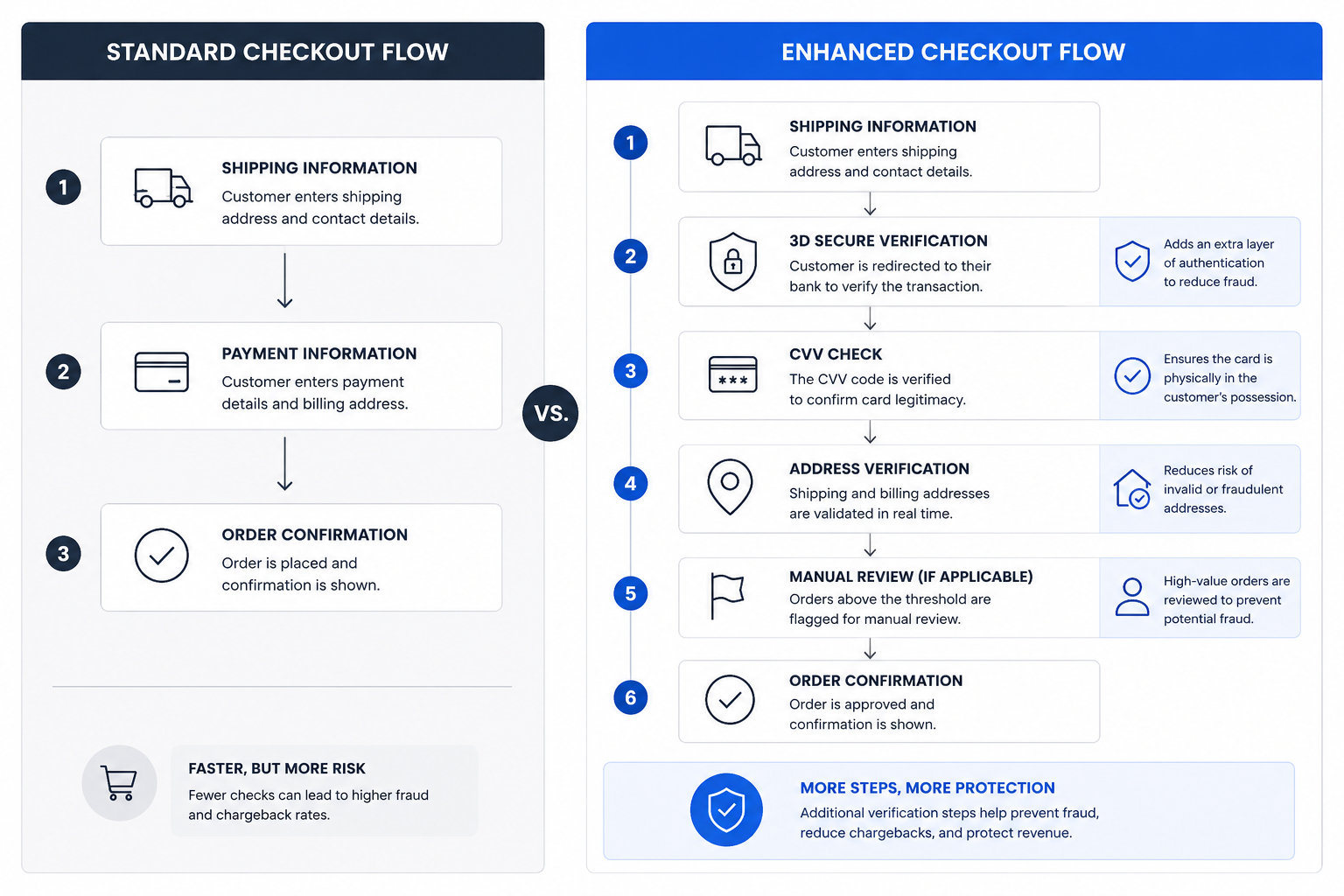
Checkout flow comparison: standard process versus enhanced flow with address verification and manual review trigger for high-value orders
Address Autocomplete and Verification at Checkout
Place Autocomplete speeds up address entry and reduces input errors, allowing customers to move easily through the checkout [4]. Use Place Autocomplete to initially capture the address, use Address Validation API to confirm the entered address, and display the entered address on a map to give customers delivery confidence [4]. This three-step approach ensures that customers see exactly where their order will be delivered before they complete payment.
Implementing address autocomplete has measurable conversion benefits. Adding address autocomplete increased checkout conversion by 1.5% in one A/B test [5]. In Germany, address autocomplete raised new-customer conversion by 3.6% [6]. In Canada, address autocomplete raised new-customer conversion by 15.0% [6]. In Spain, address autocomplete raised new-customer conversion by 9.6% [6]. In France, address autocomplete raised new-customer conversion by 1.6% [6]. The variation across markets reflects differences in address complexity and customer expectations.
For high-value orders, consider adding a confirmation step after address validation. Apply extra verification only to high value carts, using 3D Secure, CVV checks, and address verification for orders above a defined threshold [7]. This layered approach balances friction with protection. Standard orders flow through quickly, while high-ticket purchases receive additional scrutiny without requiring manual intervention for every transaction.
Confirm identity using email verification, phone confirmation, or manual review for flagged orders [7]. When an order triggers your high-value threshold and the address validation returns a low-confidence score, route the order to a brief manual review queue. A support team member can call the customer to confirm the address and delivery preferences before the order ships. This adds a few hours to fulfillment time but eliminates the risk of shipping a valuable item to an incorrect or fraudulent address.
Operational Controls for High-Value Shipments
Validate declared value at point of sale and in warehouse systems to ensure automatic carrier rules trigger reliably [8]. Many carriers apply different handling and liability rules once a shipment exceeds a certain value. If your order management system does not pass the correct declared value to the carrier, these protections will not activate. Confirm that your integration sends the full order value, not just the shipping cost or a default placeholder.
Require signature and tracked delivery: Always use carriers with signature confirmation [7]. For addresses with a history of INR claims, require adult signature or hold-for-pickup [8]. Signature confirmation provides proof of delivery that is critical for disputing chargebacks. Hold-for-pickup options give customers control over delivery timing and eliminate the risk of packages left unattended at a doorstep.
Present clear messaging in confirmation emails and tracking pages so customers expect to sign, lowering refusal or confusion-related exceptions [8]. Send clear order confirmations, shipping updates, and delivery notifications to customers [7]. Include a note in the shipping confirmation that explains the signature requirement and provides instructions for scheduling delivery or redirecting to a pickup location. This reduces failed delivery attempts caused by customers being unavailable to sign.
Confirm whether declared value equals insured value or if additional commercial insurance is required for full coverage beyond carrier liability caps [8]. Carrier liability limits often fall short of the actual product value for high-ticket items. If your shipment is lost or damaged, you may only recover a fraction of the order value unless you purchase additional insurance. Review your carrier contracts to understand the default liability cap and add supplemental coverage for orders that exceed it.
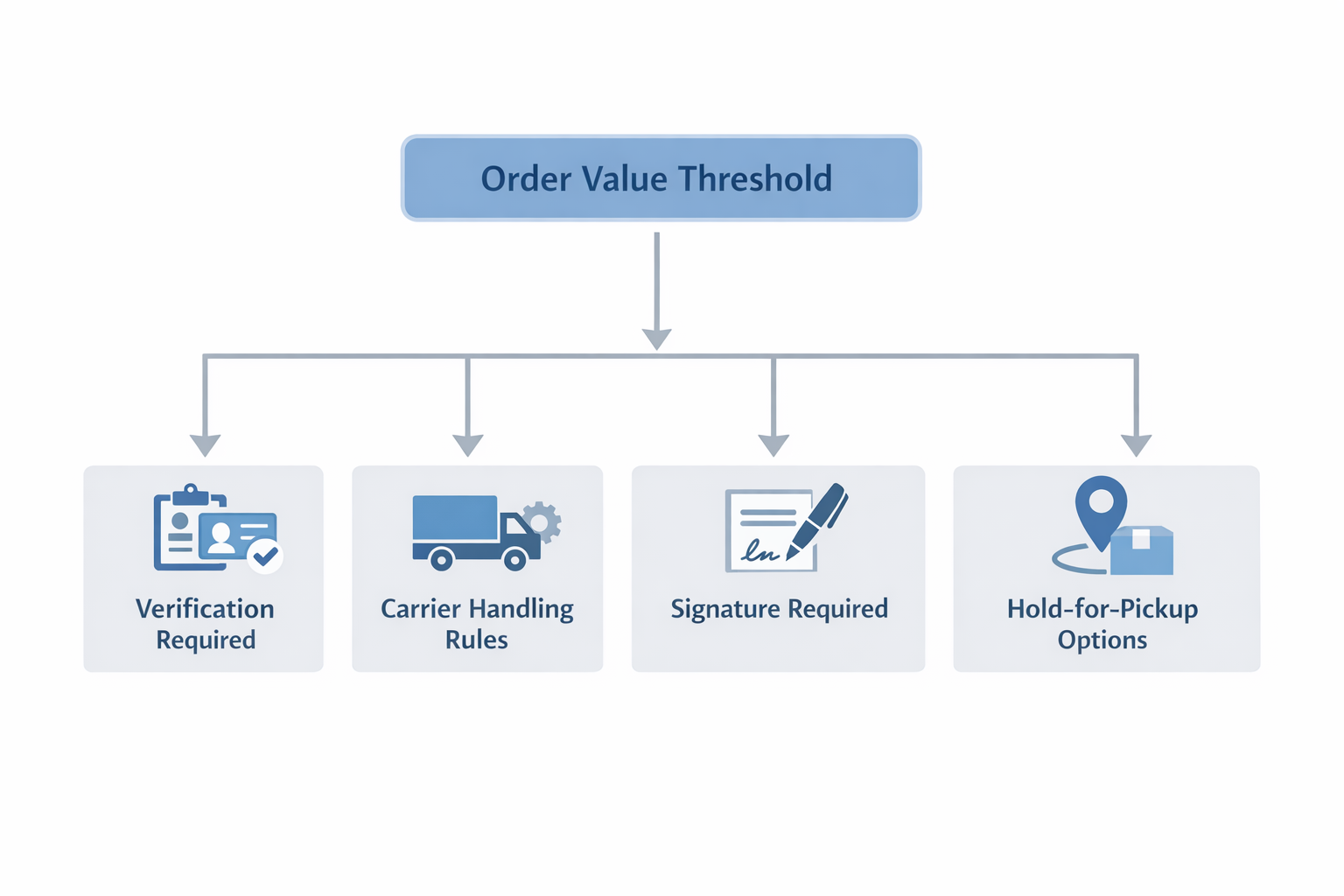
Decision flowchart: order value threshold triggers verification, then determines shipping method, signature requirement, and hold-for-pickup eligibility
Payment Method and Regional Considerations
Cash on delivery (COD) remains prevalent in certain markets and introduces unique risks for high-value orders. About 60.7% of online stores in Poland offer cash on delivery [9]. About 85.6% of online stores in Greece offer cash on delivery [9]. Cash on delivery accounts for about 51% of Romanian online orders [10]. When a customer places a high-value order with cash on delivery, the merchant bears the full risk of a refused delivery or incorrect address.
The single most effective way to reduce fake COD orders is to confirm them before you ship, and the most effective channel for that confirmation is WhatsApp [11]. For orders above your defined high-value threshold, send a confirmation message via WhatsApp, SMS, or phone call before dispatching the shipment. Ask the customer to confirm the delivery address, the order contents, and their availability to receive the package. This simple step eliminates most fraudulent or mistaken orders.
Regional address formats also affect delivery success. In Romania, the county field is a required component of the address and must be validated separately from the city or postal code. In Poland, phone number validation is critical because carriers often call customers to coordinate delivery times. Ensure that your checkout form includes all required local address fields and validates them according to regional postal standards. Missing or incorrectly formatted fields are a common cause of delivery failures in Central and Eastern European markets.
Pre-Shipment Confirmation and Customer Communication
For high-value orders, implement a pre-shipment confirmation workflow that requires explicit customer acknowledgment before the order leaves your warehouse. Send an email or SMS that includes the full delivery address, the order contents, the expected delivery date, and a clear call-to-action for the customer to confirm or update the information. If the customer does not respond within a defined timeframe, follow up with a phone call before shipping.
This confirmation step serves multiple purposes. It catches address errors that slipped through checkout validation, it confirms that the customer still wants the order, and it provides documented proof that the customer acknowledged the shipment details. In the event of a chargeback, this confirmation record strengthens your dispute evidence. Include a statement in the confirmation message that the customer is responsible for providing an accurate delivery address and that refusal or non-delivery due to an incorrect address will not qualify for a refund.
For luxury brands, frame this confirmation as a white-glove service rather than a fraud prevention measure. Use language that emphasizes your commitment to ensuring a perfect delivery experience. Offer concierge options such as scheduled delivery windows, alternative delivery addresses, or hold-for-pickup at a premium location. This approach maintains the brand experience while still achieving the operational goal of address verification.
Measuring Impact and Testing Changes
Key metrics to track include conversion rates, tool interaction, delivery success, address change rates, and residential vs. commercial data accuracy [12]. Establish a baseline for each metric before implementing checkout changes. Track conversion rate by order value segment, not just overall conversion. A change that improves conversion for low-value orders may reduce conversion for high-value orders if it adds friction at the wrong point in the flow.
Monitor address correction rate as a leading indicator of delivery success. If customers frequently override or correct the address suggested by autocomplete, it may indicate that your validation service is not tuned for your market or that your address form is missing required fields. Track the percentage of orders that require manual review and the time spent per review. If manual review volume becomes unsustainable, raise your high-value threshold or refine your fraud scoring rules to reduce false positives.
Measure chargeback rate specifically for orders above your high-value threshold. Compare this rate before and after implementing address verification and pre-shipment confirmation. Track the reason codes for chargebacks to identify whether disputes are driven by non-delivery, fraud, or customer dissatisfaction. If non-delivery chargebacks decline but fraud chargebacks increase, your address verification may be catching honest mistakes but not deterring deliberate fraud.
Run A/B tests for each checkout change, isolating one variable at a time. Test address autocomplete separately from the confirmation step. Test different threshold values for triggering manual review. Test different messaging in pre-shipment confirmation emails. Use a holdout group that experiences the original checkout flow to ensure that any conversion lift is attributable to the change and not to seasonal variation or other factors.
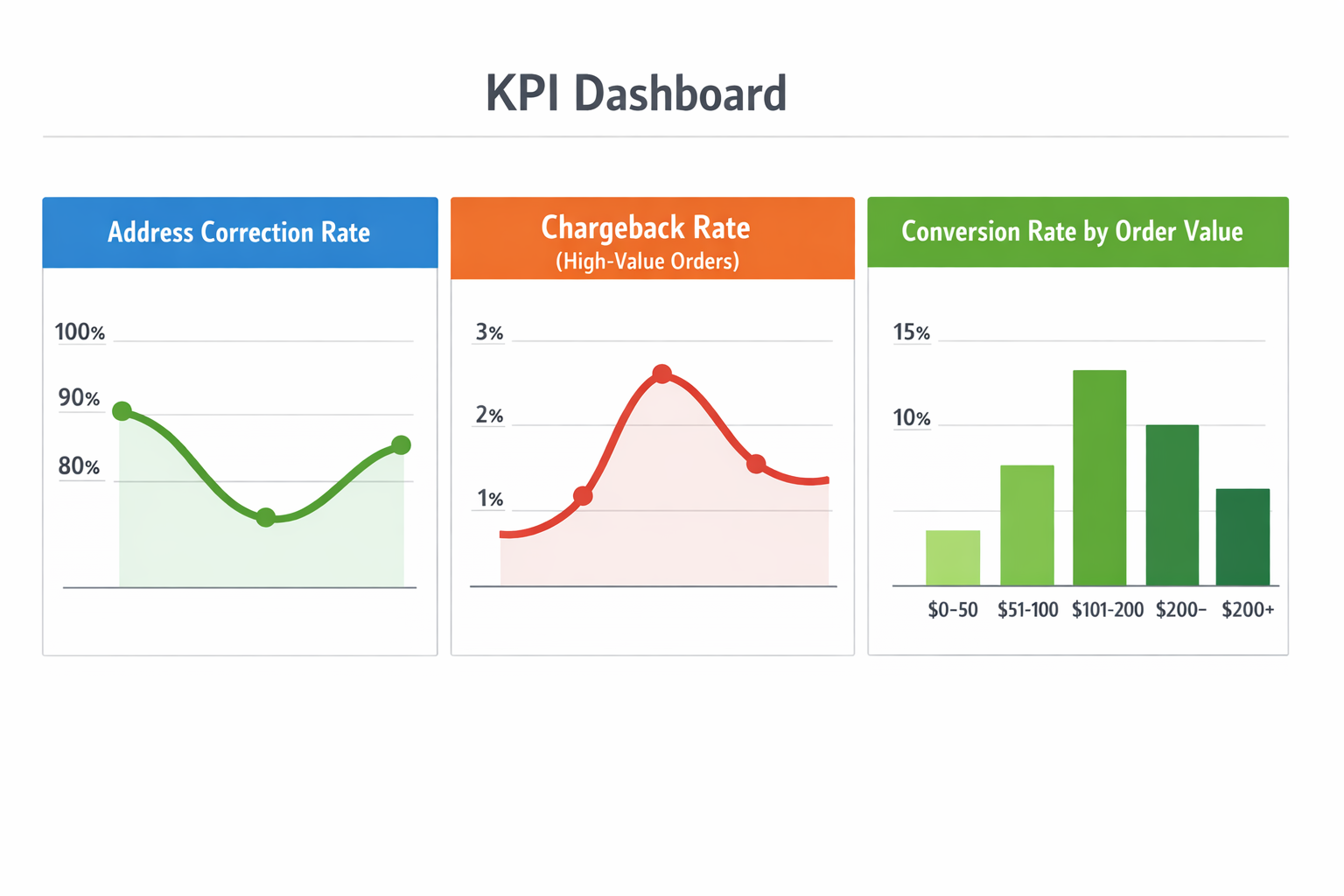
KPI dashboard template: address correction rate, chargeback rate for orders above threshold, and conversion rate segmented by order value
Implementation Checklist
- Integrate address autocomplete and validation API at checkout to reduce input errors and confirm delivery addresses before payment
- Define a high-value order threshold and apply extra verification steps including 3D Secure, CVV checks, and address verification for orders above that threshold
- Validate declared value at point of sale and in warehouse systems to ensure automatic carrier rules trigger reliably
- Require signature confirmation and tracked delivery for all high-value shipments, and use hold-for-pickup for addresses with a history of delivery issues
- Send pre-shipment confirmation messages via email, SMS, or WhatsApp for high-value orders, requiring customer acknowledgment before dispatch
- Track conversion rates, address correction rates, delivery success rates, and chargeback rates by order value segment to measure impact
- Confirm whether declared value equals insured value or if additional commercial insurance is required for full coverage beyond carrier liability caps
Conclusion
Implementing address validation, pre-shipment confirmation, and targeted operational controls creates a layered defense against delivery failures and chargebacks on high-value orders. These tactics reduce the cost of address errors, protect margin on expensive products, and provide documented evidence for dispute resolution. Tracking the right metrics allows you to refine thresholds and processes over time, balancing friction with protection. Which of these controls will have the greatest impact on your current chargeback rate?
SUBMIT YOUR COMMENT