

AI makes product comparisons instant—your specs won't win. When algorithms surface identical features and pricing across competitors in milliseconds, functional parity becomes the baseline, not the differentiator. The brands that resist commoditization are those that anchor their positioning in something deeper: a clear vision that creates emotional commitment, customers and algorithms notice. This shift is urgent because consumer trust in manufactured persuasion is collapsing—53% of consumers do not trust influencer content at all [1]. Meanwhile, e-commerce brands see a 60% higher customer lifetime value when they start using retention marketing early on [2]. The opportunity is to translate an aspirational brand vision into concrete product differentiation, membership benefits, and measurable attitudinal metrics—so your brand builds loyalty that outlasts the next algorithm update.
Why Functional Parity No Longer Protects Market Position
The global AI-in-retail market is forecasted to reach $31 billion by 2028 [3]. This expansion reflects how rapidly AI tools are becoming embedded in consumer purchase journeys, from product discovery to price comparison. When shoppers can instantly surface identical specifications, materials, and pricing across dozens of competitors, the traditional moat of product superiority erodes. Brands that rely exclusively on feature lists or technical advantages find themselves competing in a zero-sum game where the lowest price or fastest shipping wins by default.
Only 4% of e-commerce search queries had AI-generated overviews in early 2025 [3]. While this figure is still low compared to sectors like education or healthcare, it signals the beginning of a structural shift. As AI-generated answers become more prevalent in search results, the window for brands to differentiate on information asymmetry narrows. The implication is that brands must shift their competitive strategy from hiding or highlighting product details to building a distinct identity that cannot be replicated by a feature matrix.
Consumer goods subscription services face a 10% monthly churn rate, which translates into an average lifespan of just 10 months [4]. This churn rate underscores the fragility of transactional relationships. When customers perceive no emotional or experiential difference between brands, they switch freely based on convenience or price. The absence of a compelling brand vision leaves no reason for customers to stay beyond the immediate utility of the product.
A 5% increase in customer retention can lead to a 25% increase in profits [2]. This leverage effect demonstrates why attitudinal loyalty—customers choosing your brand because of what it represents, not just what it does—matters more than acquisition volume. Retention-driven growth compounds over time, reducing the cost of serving each customer and increasing the lifetime value of the relationship. The challenge is that retention cannot be engineered through discounts or feature additions alone; it requires a brand vision that gives customers a reason to return.
Step 1: Craft a Brand Vision That Is Aspirational, Achievable, and Clear
A brand vision works best when it is concise—keep it to one or two sentences, avoiding unnecessarily vague terms, jargon, or lofty promises that you will not be able to keep [5]. Simplicity is power: the clearer the vision, the easier it is to remember, repeat, and use across every customer touchpoint. A vision that requires a paragraph to explain will not survive internal alignment meetings, let alone resonate with customers in a crowded market.
Collect input for the vision statement from across the business: include employees, leadership, and even customers or partners, because when people help shape the vision, they are more likely to embrace it and act on it [5]. This collaborative process surfaces the language and priorities that already exist within the organization, rather than imposing a top-down mandate that feels disconnected from daily operations. The vision becomes a shared reference point that guides product development, marketing messaging, and customer service decisions.
Look inward and ask yourself what strengths, differentiators, or qualities set your brand apart, then highlight your points of difference and align your vision with your identity to ensure your vision is authentically you [5]. Authenticity is not a buzzword here—it is the filter that prevents your vision from sounding like a generic mission statement borrowed from a competitor. If your vision could be copied and pasted onto another brand's website without anyone noticing, it is too vague to create differentiation.
As noted earlier, a 5% increase in customer retention can lead to a 25% increase in profits [2]. This same data point also shows that the economic value of a clear brand vision is not abstract—it translates directly into retention behavior. When customers understand what your brand stands for, they are more likely to choose you again, even when alternatives are functionally identical. The vision becomes the reason they stay, not just the reason they first clicked.
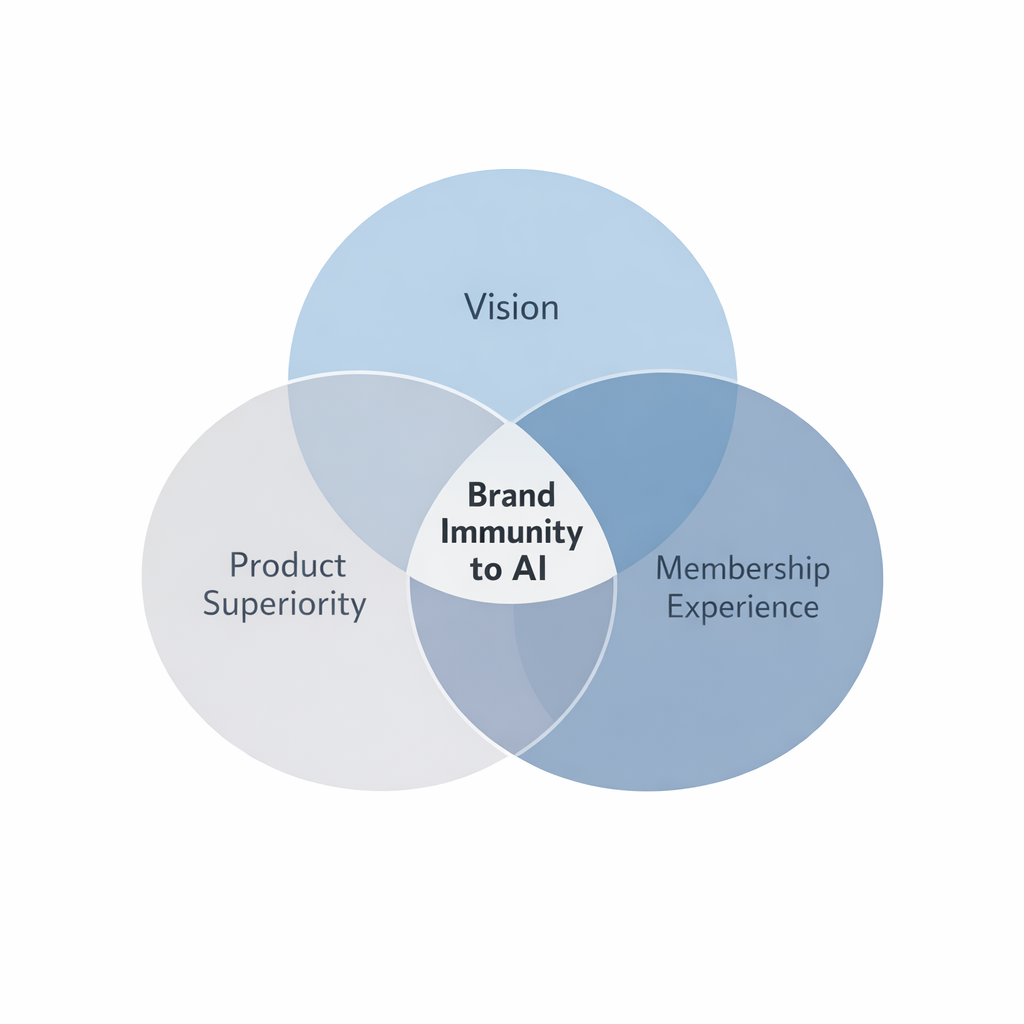
Three overlapping circles labeled Vision, Product Superiority, and Membership Experience, with the intersection labeled Brand Immunity to AI
Step 2: Translate Vision Into Offers That Reward Preference
Offering exclusive promotions to loyalty program members is the most straightforward way to capture the benefits of integrated pricing and loyalty, because it makes the value proposition of loyalty programs abundantly clear and can encourage extra sign-ups from non-loyalty customers [6]. Price-based loyalty benefits are typically very effective because they establish a strong, clear link between the program and the value it delivers. The key is to structure these offers so they reinforce the brand vision rather than undermine it—discounts should feel like insider access, not desperation.
The most effective loyalty strategies combine immediate transactional benefits, such as points or discounts, with emotional elements like community, personalization, and experiences, rather than choosing one or the other [7]. This dual approach addresses both the rational and emotional drivers of repeat purchase behavior. Transactional rewards satisfy the immediate need for value, while emotional benefits create a sense of belonging that is harder for competitors to replicate.
Adidas' adiClub goes beyond simple transactional benefits by focusing on experiential rewards, community building, and lifestyle integration, offering exclusive access to product drops, tickets to sporting events, and personalized experiences like meeting athletes [7]. It aligns with Adidas' core values by making membership feel like participation in a movement, not just a discount program. This approach transforms the loyalty program into a manifestation of the brand vision, where every benefit reinforces what the brand stands for.
In one loyalty program beta test, 40% of customers opted in [4]. This opt-in rate demonstrates that customers are willing to engage with structured loyalty programs when the value proposition is clear and aligned with their expectations. The challenge is to design the program so that participation feels like a natural extension of the brand relationship, not an administrative burden.
In a loyalty pilot, 42% of customers placed 50 or more orders [4]. This level of engagement signals that a well-designed loyalty program can drive extraordinary frequency among a core segment of customers. These high-frequency buyers become the economic engine of the brand, generating disproportionate revenue and serving as advocates who amplify the brand vision through word-of-mouth.
Step 3: Build an Influencer Strategy That Prioritizes Authenticity Over Reach
Look for consistency in the influencer's message: Do they talk about their values in the same way across their posts? Also consider how genuine their content feels—is the influencer enthusiastic in how they talk to their followers, and do they show passion and interest in the topics that matter to your brand? [8] This consistency is the signal that the influencer's advocacy will feel organic rather than transactional. When an influencer's values align with your brand vision, their endorsement reinforces the emotional commitment you are trying to build with customers.
Seeding—sending free products to creators with no obligation to post—remains one of the most effective ways to spark authentic advocacy, because there is no payment involved, it feels lower-risk for smaller businesses while giving influencers the freedom to share only what they truly like [9]. This approach removes the transactional pressure that often makes influencer content feel forced. When creators choose to share your product without a contractual obligation, their audience perceives the endorsement as genuine, which amplifies the trust transfer.
Document your compliance standards by detailing your brand voice, messaging rules, and restrictions, such as avoiding misleading promotions or unauthorized discount codes, and include specific examples of compliant versus non-compliant practices so that affiliates can easily understand the dos and don'ts [10]. These guardrails protect your brand vision from being diluted by off-message promotions. When affiliates and influencers understand the boundaries, they can create content that reinforces your positioning rather than undermining it.
Share pre-approved content by providing a library of on-brand images, ad copy, and landing pages, which can minimize off-message promotions, because by providing these assets, affiliates can quickly and easily integrate compliant materials without creating their own, reducing the likelihood of inconsistency [10]. This operational step ensures that every piece of influencer or affiliate content reflects the brand vision, even when you are not directly controlling the creative process. The pre-approved library becomes a tool for scaling authentic advocacy without sacrificing brand integrity.
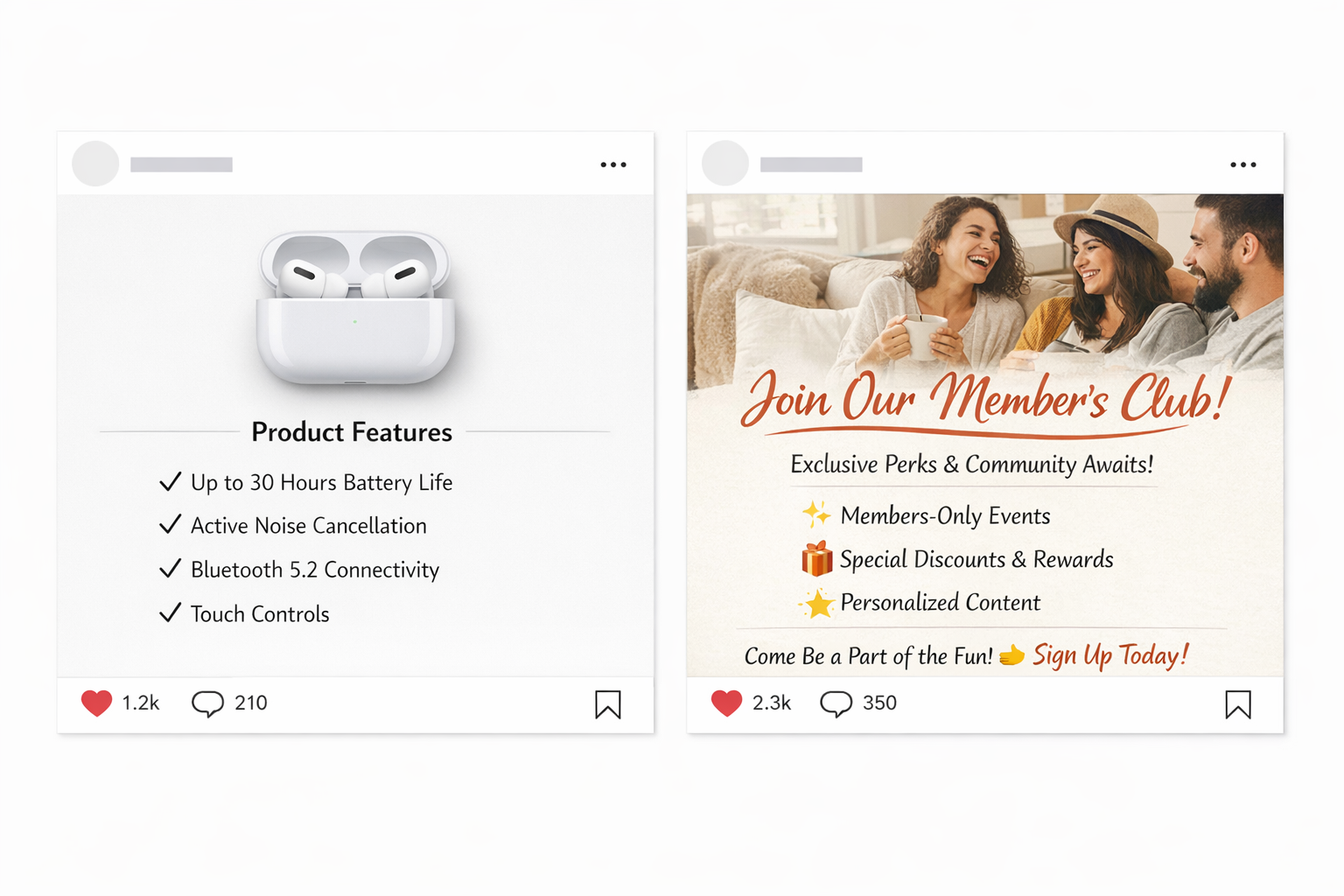
Side-by-side comparison of two social media posts: one listing product specifications, the other inviting readers to join a membership experience
How to Measure Attitudinal Loyalty and Branded Search Lift
Google Search Console added a new card to the Insights report that shows the breakdown of total clicks for branded versus non-branded traffic, helping you measure brand recognition and compare the volume of traffic from people already familiar with your brand to the volume of traffic from those who did not explicitly intend to visit your site [11]. This metric provides a direct window into whether your brand vision is creating top-of-mind awareness. When branded search volume increases, it signals that customers are actively seeking your brand by name, rather than discovering you through generic product searches where AI-generated comparisons dominate.
Google searches for customer retention rose by 42% between 2018 and 2021 [2]. This surge in search interest reflects a broader industry recognition that retention is the new growth frontier. Brands that track branded search lift alongside retention metrics can identify whether their vision-driven messaging is translating into sustained customer interest, not just one-time conversions.
Casper's customer retention increased by 25% [2]. This improvement demonstrates that retention gains are achievable when brands invest in strategies that go beyond acquisition. The challenge is to isolate which initiatives—whether brand vision campaigns, loyalty programs, or experiential rewards—are driving the retention lift, so you can allocate resources accordingly.
As noted earlier, e-commerce brands see a 60% higher customer lifetime value when they start using retention marketing early on. This earlier result also highlights that the timing of retention investment matters. Brands that wait until churn becomes a crisis are fighting an uphill battle, whereas those that embed retention thinking into their brand vision from the start capture the compounding benefits of loyalty over time.
Practical Steps to Test Vision-Driven Messaging
Run a controlled experiment over 60 days to compare vision-driven messaging against product-only messaging. Split your audience into two cohorts: one receives communications that emphasize your brand vision, membership benefits, and emotional positioning, while the other receives traditional product-focused messaging with specifications and features. Track branded search volume, repeat purchase rate, and opt-in rates for loyalty programs across both cohorts. This experiment isolates whether your brand vision is creating measurable attitudinal loyalty or whether customers are responding primarily to functional claims.
Add one attitudinal survey question to your post-purchase email sequence. Ask customers to rate their agreement with a statement like, "This brand represents values that are important to me." Use a five-point scale and track the distribution of responses over time. This single question provides a leading indicator of emotional commitment that precedes repeat purchase behavior. If the attitudinal score improves while repeat purchase rates remain flat, it signals that your brand vision is resonating but that operational friction or competitive offers are preventing conversion.
Benchmark your branded search share by filtering Google Search Console data to isolate queries that include your brand name. Compare the volume of branded clicks to total clicks each month. If branded search share increases while total traffic remains stable, it indicates that your brand vision is driving preference rather than just awareness. This metric is especially valuable because it reflects customer intent—people who search for your brand by name are already predisposed to choose you over alternatives.
Checklist: Implementing a Vision-Driven Brand Strategy
- Draft a one- to two-sentence brand vision that is concise, avoids jargon, and highlights your points of difference
- Collect input from employees, leadership, and customers to ensure the vision is authentically aligned with your identity
- Design exclusive promotions for loyalty program members that make the value proposition abundantly clear
- Combine transactional benefits like points or discounts with emotional elements such as community and personalized experiences
- Evaluate influencers for consistency in their message and genuine enthusiasm for topics that matter to your brand
- Send free products to creators with no obligation to post, giving them freedom to share only what they truly like
- Document compliance standards with specific examples of compliant versus non-compliant practices for affiliates
Conclusion
When you build a brand vision that is aspirational, achievable, and clear, you create a foundation for loyalty that survives algorithmic comparison. By translating that vision into membership benefits, experiential rewards, and authentic influencer partnerships, you give customers a reason to choose your brand beyond functional parity. Measuring branded search lift and attitudinal loyalty ensures you can track whether your vision is creating the emotional commitment that drives retention. How will you translate your brand vision into a measurable competitive advantage that algorithms cannot replicate?


SUBMIT YOUR COMMENT