

When growth plateaus, DTC brands face three choices. This framework reveals the financial thresholds, metrics, and tactical playbooks to decide and act. Most established DTC brands are growing at only low single digits, with median revenue growth of roughly 3% in early 2025 [1]. High customer acquisition costs and weak retention profiles have become the norm: brands that averaged $34 in CAC in 2021 were averaging $57 in 2024 [2]. At the same time, 47 of 50 studied DTC brands lacked meaningful loyalty programs [3]. The path forward requires a deliberate choice: revive the brand, reframe the strategy, or retire responsibly.
Spotting the Stall: Early-Warning Metrics
Most DTC categories see repeat purchase rates under 20% [4]. This low retention baseline makes acquisition-driven growth unsustainable when channel costs rise. When CAC crosses 45% of first-order AOV and stays there for 60+ days, the channel or audience is saturated [5]. Either the channel is pivot-worthy, or the audience is pivot-worthy.
As noted earlier, brands that averaged $34 in CAC in 2021 were averaging $57 in 2024 [2]. This 68% increase in acquisition cost over three years signals that paid channels have become less efficient for many brands. The gap between acquisition cost and customer lifetime value narrows when retention mechanisms are absent.
Concentration risk above 70% is a pivot signal in disguise [5]. If one product drives everything, the rest of the business is drag. If one channel drives everything and that channel's costs are rising, you must diversify or pivot before the channel prices you out. This threshold marks the point where operational efficiency cannot compensate for structural dependency.
If conversion rate has not moved more than ±0.2 percentage points across three consecutive quarters despite active CRO work, the store has hit a ceiling that CRO cannot break through [5]. This stagnation indicates that the problem lies in positioning, audience fit, or product-market alignment rather than site optimization.
31 of 50 DTC brands experienced founder departure or material founder-role change between Series B and Series C [6]. Leadership transitions during growth-stage funding often coincide with strategic drift and declining brand coherence.
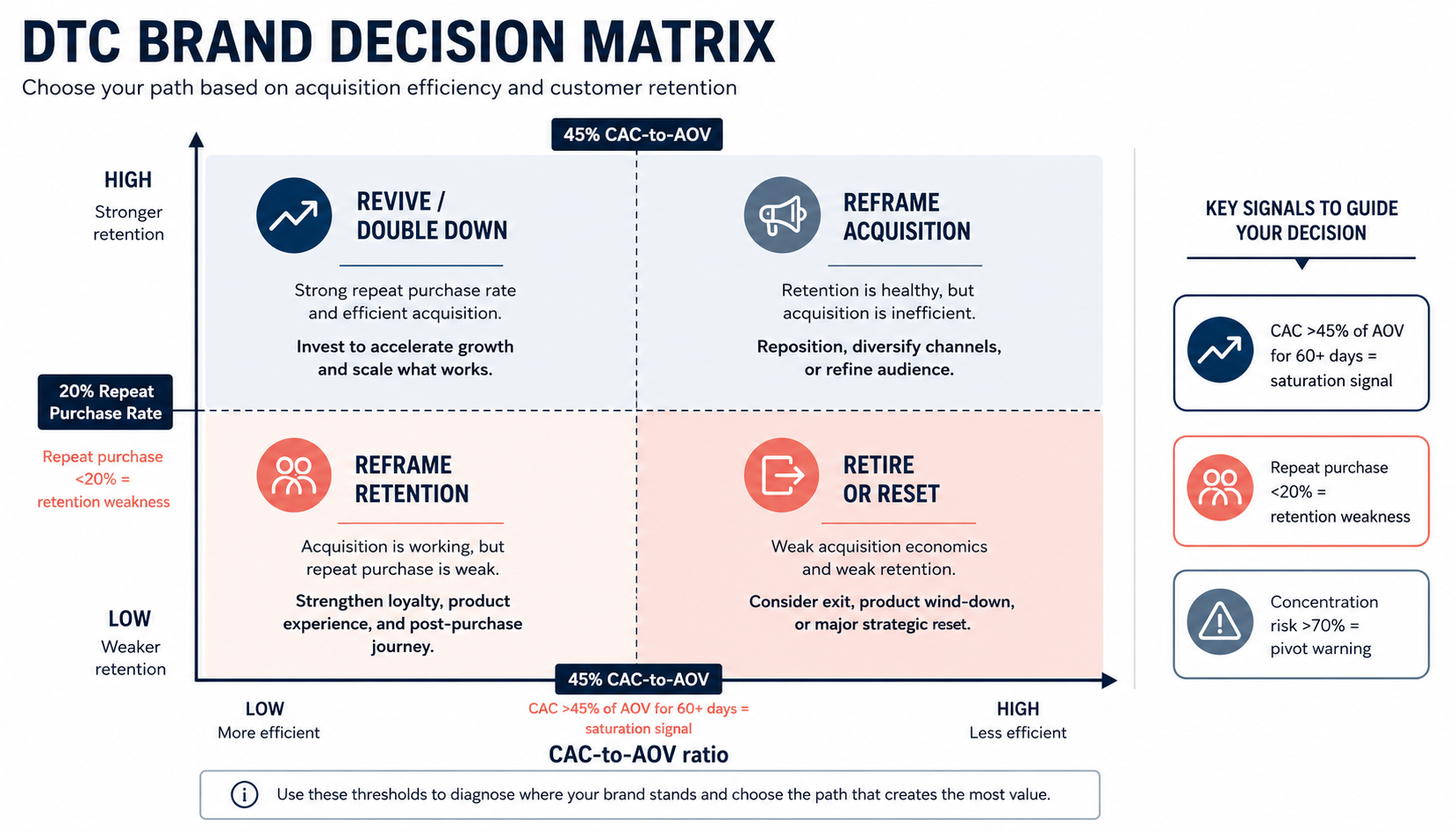
Decision matrix mapping CAC-to-AOV ratio and repeat purchase rate to strategic path selection
Path One: Revive the Brand
Warby Parker grew revenue 15.2% and customers 9% in Q3 2025 [7]. The company combined in-house lens labs and disciplined marketing to achieve profitability while maintaining growth. This outcome required multi-year investment in brand infrastructure and operational control.
e.l.f. Beauty reported a 28% net sales increase in fiscal 2025 [8]. The brand's revival centered on consistent product innovation and mass-market accessibility. Revival at this scale demands sustained investment in product development and distribution expansion.
Hybrid marketing models played an important role in brand revival efforts and drove an average 27% drop in CAC. At the same time, LTV:CAC improved to 2.1× versus 1.3× in-house and 1.1× pure agency. About 80% of analyzed brands shifted to hybrid marketing after growth stalled [9].
The previously cited 27% CAC reduction also indicates that organizational structure directly impacts acquisition economics. Brands that combine internal strategic control with external execution capacity achieve better unit economics than those relying solely on one model. The 2.1× LTV:CAC ratio represents a sustainable growth threshold where customer lifetime value justifies acquisition spending.
Path Two: Reframe the Strategy
Repositioning campaigns typically reduce CPA by at least 15% within 90 days of the repositioned campaign going live [10]. This outcome requires tightening the target audience and concentrating messaging around a narrower value proposition. The speed of improvement reflects how quickly a more focused message resonates with a better-matched audience.
Most brands can remove 40–50% of their product range without any substantial loss, with a maximum revenue impact of 10% or less [11]. Consolidating the product lineup simplifies inventory and marketing, enabling richer product pages and preventing wasted ad spend on low-converting items. This SKU reduction improves conversion rates by eliminating choice paralysis.
Looking again at the 15% CPA drop within 90 days, this metric also highlights the importance of rapid testing. Brands that reframe their positioning can validate the new approach within a single quarter, allowing for course correction before significant budget is consumed. The three-month window provides enough data to assess whether the repositioned messaging improves audience fit.
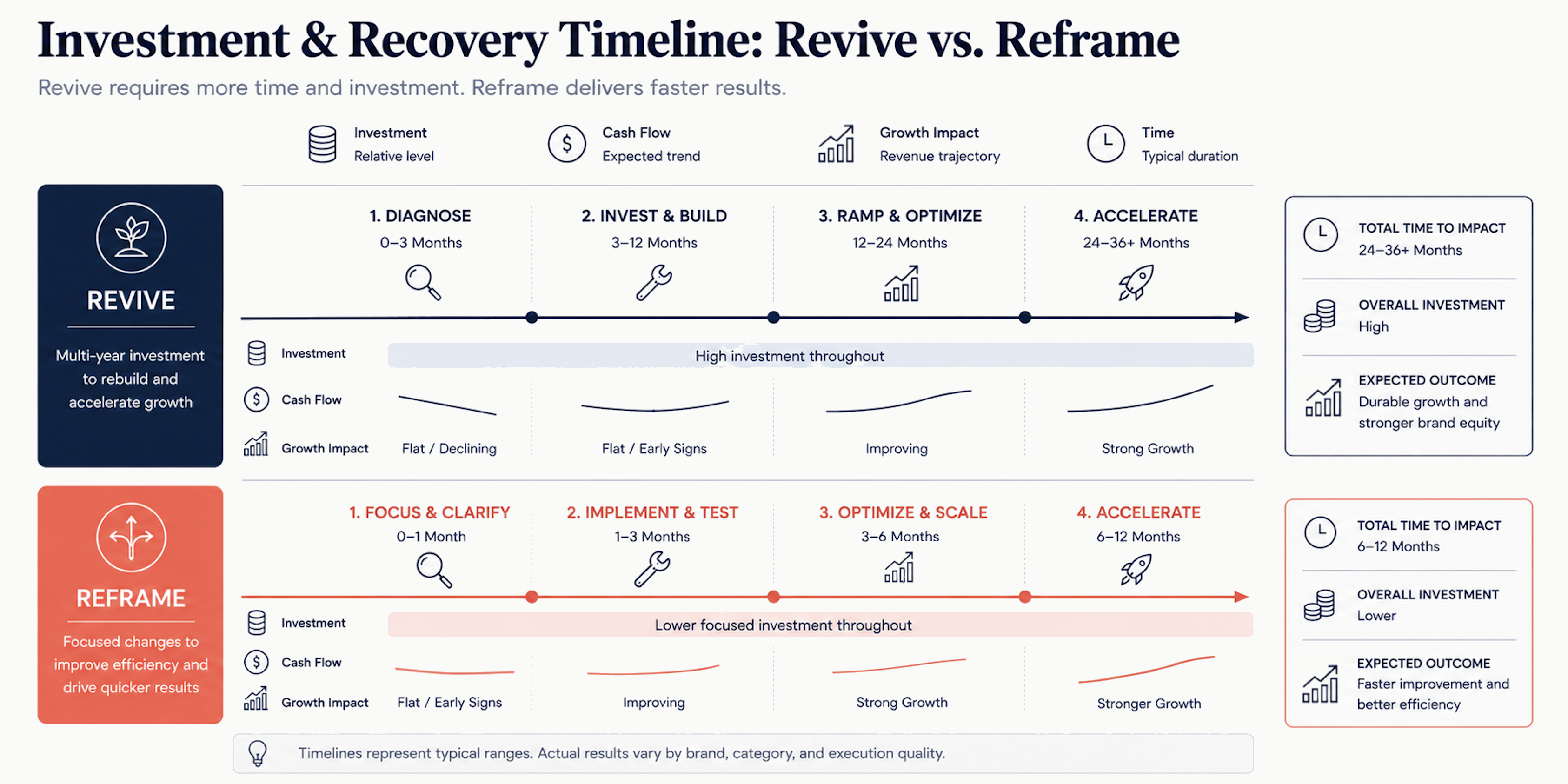
Timeline showing investment requirements and recovery periods for revive and reframe strategies
Tactical Steps for Reframing
Consolidate your product lineup by cutting roughly 40–50% of SKUs, losing at most 10% of revenue [11]. Focus on core products to simplify inventory and marketing. This enables richer product pages, avoiding choice paralysis, and prevents wasted ad spend on low-converting items, improving conversion rates. Start by analyzing revenue contribution per SKU and identifying products that generate less than 2% of total revenue individually.
Optimize each product page for AI by using benefit-first copy and defining the intended customer [13]. Lead with what the product does and who it's for, not just features. Include a "Best for: ... Not recommended for: ..." statement specifying the ideal user. Add a targeted FAQ section on the page, as AI often surfaces FAQs in answers. This structure helps AI systems match products to queries precisely.
Implement schema.org structured data across your site [13]. Add an Organization schema on your homepage, including brand name, core narrative description, foundingDate, and founder. On each product page, use a Product schema including brand, a benefit-focused description, category, and a PeopleAudience "audienceType" for the ideal customer. This tells AI exactly what your brand and products are.
Incorporate a systematic review request sequence post-purchase [13]. Day 5 after delivery: send a friendly check-in email with no review, ask to build rapport. Day 12: email asking for a review, linking to Trustpilot or Google with product-specific context. Day 20: follow up once for non-responders with a new subject line. Day 30: send high-value customers a request for a detailed review with prompts. Build review collection into your post-purchase sequence as a standard operational step, not an afterthought.
AI and Search Visibility Impact
Certified brand data led to click increases of 35.4% on Bing and 37.2% on Yahoo [14]. Structured data that search engines can verify directly improves click-through rates. This lift demonstrates that AI-powered search systems prioritize brands that provide clear, verifiable information.
Organic search drives approximately 33% of overall website traffic across key industries [15]. This share makes search visibility a critical channel for brands seeking to reduce dependence on paid acquisition. Brands that optimize for AI and search can capture a significant portion of intent-driven traffic without incremental ad spend.
64% of consumers have expressed skepticism around AI-generated or AI-assisted content [16]. This skepticism underscores the importance of providing direct, brand-controlled information that AI systems can surface. Consumers prefer information that originates from the brand rather than algorithmically synthesized summaries.
This same data point also shows that consumer trust in AI-generated content remains limited. Brands that rely solely on AI to communicate product benefits risk losing credibility with skeptical audiences. The solution is to ensure that AI systems pull from authoritative, brand-provided structured data rather than generating content independently.
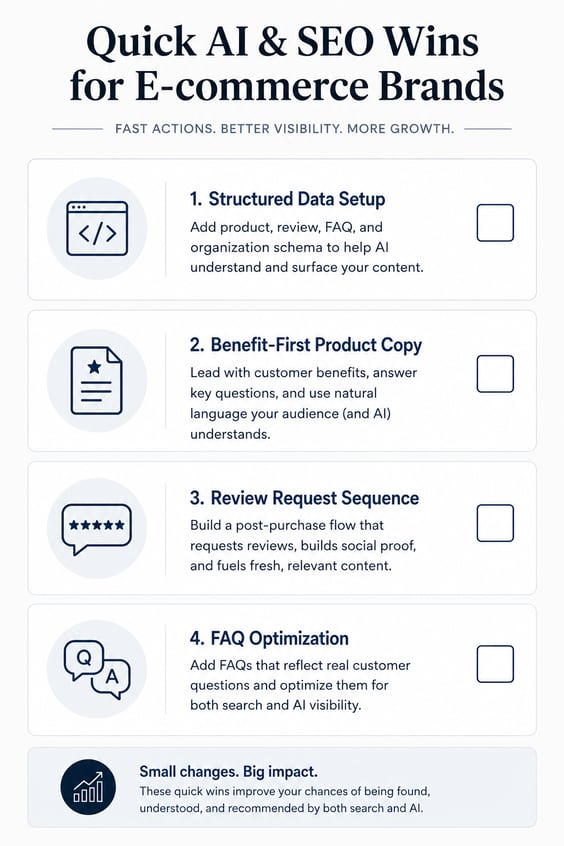
Checklist of technical and content optimizations to improve AI and search visibility
Quick Visibility Fixes
- Add Organization schema to your homepage with brand name, founding date, and core narrative description
- Implement Product schema on each product page, including brand, benefit-focused description, category, and ideal customer audience type
- Rewrite product page copy to lead with benefits and include a "Best for / Not recommended for" statement
- Build a post-purchase review request sequence with a check-in on day 5, a review ask on day 12, a follow-up on day 20, and a detailed review prompt on day 30
- Add a targeted FAQ section to each product page addressing common customer questions
Path Three: Retire Responsibly
Setting a definitive end-of-life date for the product and communicating it clearly to all stakeholders is essential [17]. The news should be shared across all company channels and external media. This date should be far enough in the future, 6–12 months, to allow for a transition period, but firm enough that stakeholders understand the product's finite lifespan. Clear communication prevents customer confusion and maintains trust during the wind-down.
For physical products, develop strategies to sell off remaining stock and parts through discounts, bundles, or other creative means [17]. Don't let write-offs eat into margins unnecessarily. Liquidating the remaining inventory is a strategic maneuver. It's about minimizing losses and transforming remaining stock into an opportunity. Bundling slow-moving inventory with popular items can accelerate clearance while preserving margin.
The previously cited 6–12 month timeline also provides sufficient runway to honor existing customer commitments and fulfill outstanding orders. Brands that rush the retirement process risk damaging relationships with loyal customers and partners. A structured timeline allows for orderly inventory liquidation and customer migration to alternative solutions.
Conclusion
Brands facing plateaued growth must choose a path based on financial thresholds and operational capacity. Reviving a brand demands multi-year investment in infrastructure and disciplined marketing, while reframing focuses resources on a narrower audience and streamlined product lineup. Retiring responsibly preserves brand equity and customer relationships through clear communication and structured inventory liquidation. Which path aligns with your current CAC-to-AOV ratio and retention profile?


SUBMIT YOUR COMMENT