

Premium D2C brands face a fundamental tension: customer acquisition costs continue climbing while one-time purchase models deliver unpredictable cash flow. Subscription and membership structures offer a path to stabilize revenue, deepen customer relationships, and build defensible competitive advantages. The global subscription e-commerce market was valued at USD 150 billion in 2023 and is expected to grow at a compound annual growth rate of 37% during the forecast period 2024-2032[1]. For brands operating at strong margins, the strategic question is no longer whether to introduce subscriptions, but how to architect them for retention and profitability.
Market Size and Growth Trajectory
The subscription economy represents a structural shift in commerce. The global D2C market was valued at $225.5 billion and is on track to hit $880.1 billion by 2034, growing at a compound annual growth rate of 14.7%[2]. Within this broader expansion, subscription models are capturing outsized attention from both consumers and investors.
In 2023, D2C brands pulled in around $135 billion in e-commerce sales, a number expected to leap to $187 billion by 2025[3]. However, US D2C ecommerce sales will plateau at around 19% of total US retail ecommerce sales by 2025 and will remain flat through 2028[4]. This plateau underscores the importance of retention-focused business models that extract more value from existing customers rather than relying solely on acquisition growth.
Gen Z is significantly more likely than the average consumer to buy directly from brands, with 28% reporting regularly purchasing D2C, compared with just 13% of the total population[5]. This demographic shift suggests that subscription models aligned with younger consumer preferences can capture disproportionate growth.
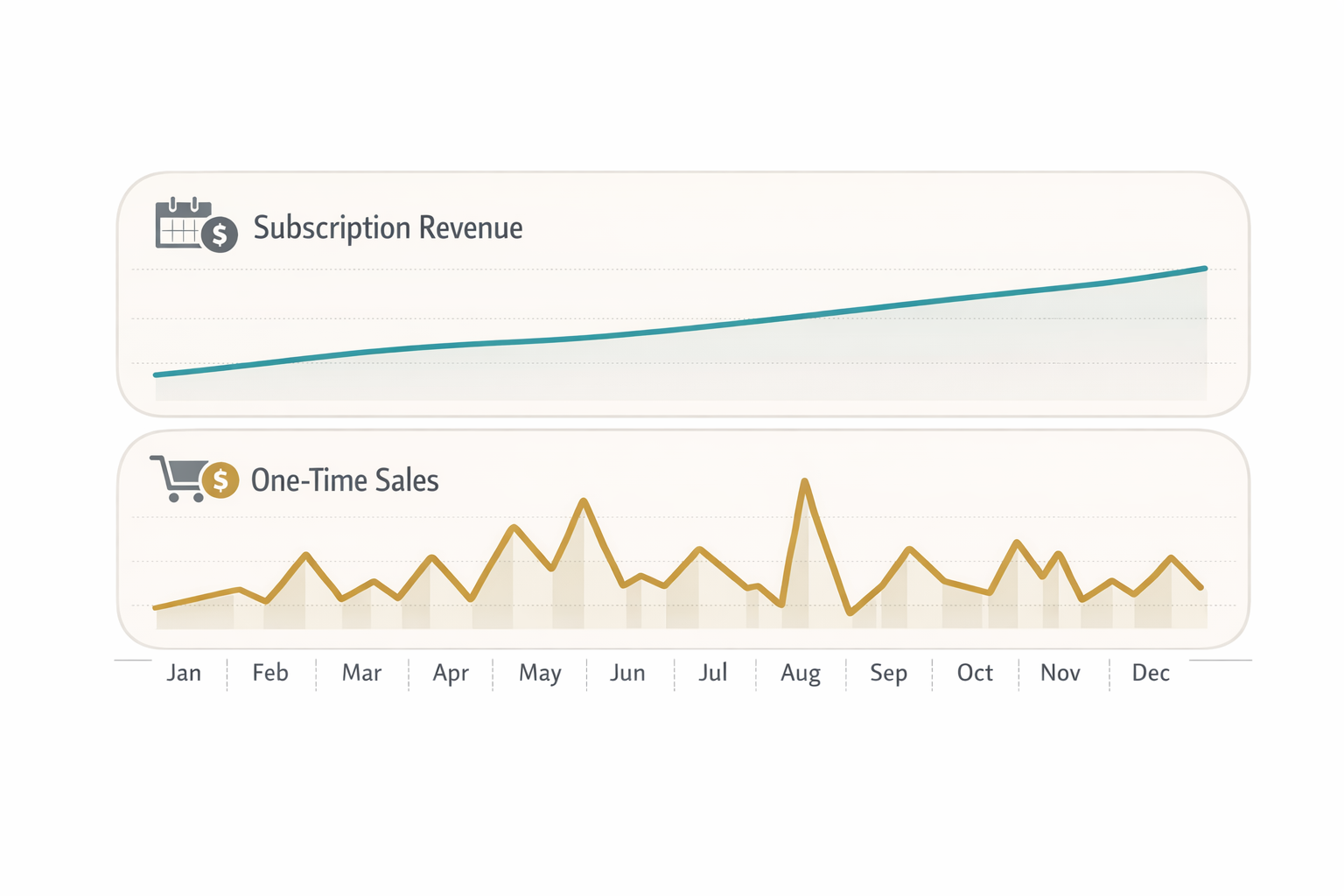
Visual representation contrasting the predictable monthly recurring revenue curve from subscriptions against the volatile spikes and troughs of one-time purchase revenue throughout a calendar year.
Customer Lifetime Value and Subscription Impact
Offering subscriptions in addition to one-time purchase options can increase customer lifetime value by 230%[6]. This uplift stems from extended purchase frequency and reduced friction in repeat transactions. Offering subscriptions alongside one-time purchases reduces the barrier to entry, making products more approachable as customers can try the products once before committing to a recurring subscription.
A 5% improvement in customer retention can increase profits by 25-95%, yet most D2C brands spend 80% of their marketing budget on acquisition and only 20% on retention[8]. This imbalance presents an opportunity for brands that reallocate resources toward subscriber engagement and retention infrastructure.
Customers with high health scores renew subscriptions at rates exceeding 90%, compared to sub-60% for those marked at-risk, demonstrating the importance of proactive engagement in retention[9]. Personalised engagement increases subscriber lifetime value by an average of 27% compared to generic messaging[10].
Subscription Churn and Retention Benchmarks
Physical box subscriptions face higher natural churn at 5-7% monthly, versus 3-5% monthly churn for digital subscriptions, primarily due to delivery friction and value perception gaps[11]. For D2C brands shipping physical goods, this baseline churn rate establishes the retention challenge that must be addressed through operational excellence and engagement strategies.
Annual billing reduces churn by 40% compared to monthly plans, as annual subscribers have already pre-committed twelve months and remove the monthly decision point where most cancellations occur[12]. This structural advantage makes annual or prepaid tiers particularly valuable for premium brands seeking predictable revenue.
Offering a subscription pause option converts 20-35% of cancellation attempts into saves, with 60-70% of paused subscribers returning when the pause period ends[13]. Pause functionality addresses temporary dissatisfaction or budget constraints without forcing a permanent exit decision.
Failed payment recovery can recapture 20-40% of involuntary churn through advanced dunning and card updater services that automatically retry secondary payment methods[14]. Involuntary churn from payment failures represents lost revenue that can be recovered through technical infrastructure rather than marketing effort.
Costco's global membership renewal rate fell from 90.4% to 89.7%, primarily due to lower engagement from digitally signed members[15]. Even established membership models face retention headwinds when digital acquisition outpaces engagement infrastructure, highlighting the importance of activation and ongoing value delivery.
Subscription Platform Technology and Pricing
Technology choices directly impact both unit economics and retention capabilities. Recharge Subscriptions charges $99/month for the Standard plan with 1.49% + 19¢ per transaction, making per-order fees a significant scaling cost that can reach $5,000-$10,000+ monthly at 50,000 orders. For brands processing substantial subscription volume, transaction-based pricing can erode margin contribution from recurring revenue.
Loop Subscriptions offers fixed monthly pricing with 0.75% transaction fees and no hidden add-on costs, with all core retention features—cancellation flows, dunning, gamification—included at every tier[17]. Fixed-fee structures provide cost predictability and can deliver better economics at scale compared to per-transaction models.
The subscription billing management market is projected to grow from $7.66 billion in 2024 to $9.16 billion in 2025, with a forecast reaching $20.61 billion by 2030 at a 17.2% CAGR[18]. This infrastructure investment reflects both the complexity of subscription operations and the strategic importance brands place on recurring revenue capabilities.
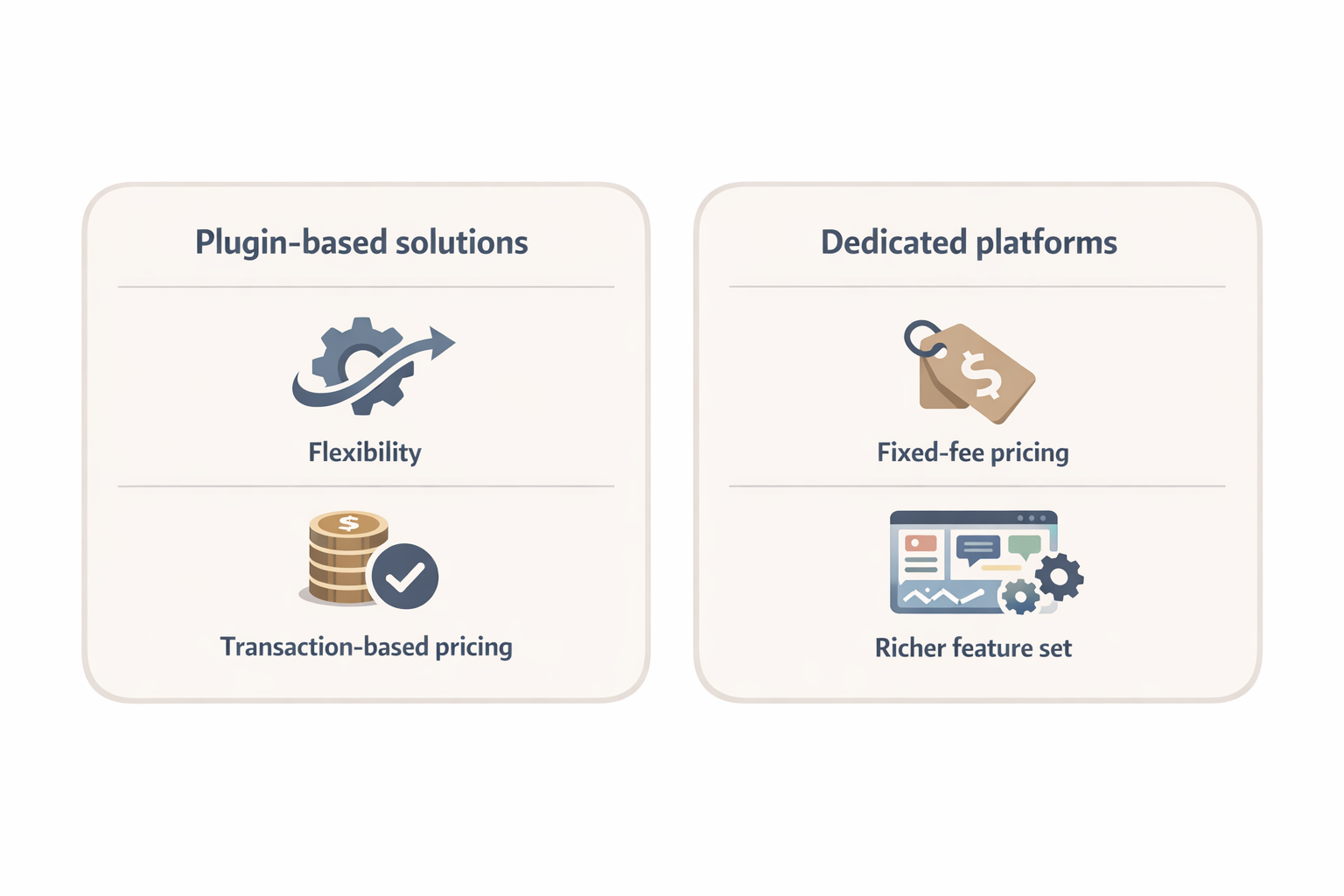
Side-by-side comparison illustrating plugin-based subscription solutions versus dedicated subscription platforms, highlighting transaction-based versus fixed-fee pricing structures and feature availability across different cost bands.
Retention and Engagement Metrics
Subscriber engagement between orders is the leading indicator of long-term retention; subscribers who open emails, log into accounts, or interact with brand content churn at 40-60% lower rates than disengaged subscribers[19]. This finding suggests that retention is determined not only by product satisfaction but by ongoing relationship strength.
73% of users are more likely to stay subscribed to a service that prioritizes transparency and robust data protection, making trust a foundational element of subscription success[20]. For premium brands, clear communication about data usage and subscription terms can differentiate retention performance.
Median Net Revenue Retention across B2B SaaS companies is 106%, with top performers exceeding 120% and growing 2.5x faster than those with low NRR, indicating expansion revenue from existing customers[21]. While this metric originates in software, the principle applies to D2C: subscribers who increase spending through tier upgrades or add-ons generate compounding value.
The average B2B SaaS churn rate is 3.5% annually, split between 2.6% voluntary churn and 0.9% involuntary churn; 75% of software companies reported declining retention rates in 2024[22]. The involuntary churn component highlights the importance of payment infrastructure in retention performance.
Pricing Tier Strategy and Customer Segmentation
The 3-tier membership model is most effective for D2C brands: an entry tier (free to join), mid tier (earn through spending), and top tier (highest spenders or paid upgrade option) drives engagement and prevents tier dilution[23]. This structure accommodates customer heterogeneity while creating clear upgrade paths that increase lifetime value.
Costco's Executive membership at $130 annually generates 2% cash back and drives significantly higher visit frequency and spending per year among upgrading members compared to Basic members[24]. The paid-tier model demonstrates that customers who invest upfront in membership access exhibit stronger engagement and spending behavior.
63% of shoppers said loyalty points would make them sign up for a subscription, demonstrating that integrating loyalty programs with subscriptions strengthens retention[25]. The combination of recurring revenue and points-based rewards creates dual incentives for continued participation.
For luxury brands, exclusivity and scarcity remain powerful retention mechanisms. Luxury brands like Chanel restrict online availability and use artificial scarcity tactics; Chanel's move to restrict online access to certain lipstick shades resulted in a 25% surge in foot traffic to flagship stores[26]. Subscription tiers for premium brands can incorporate similar exclusivity principles through limited product access, early launches, or member-only collections.
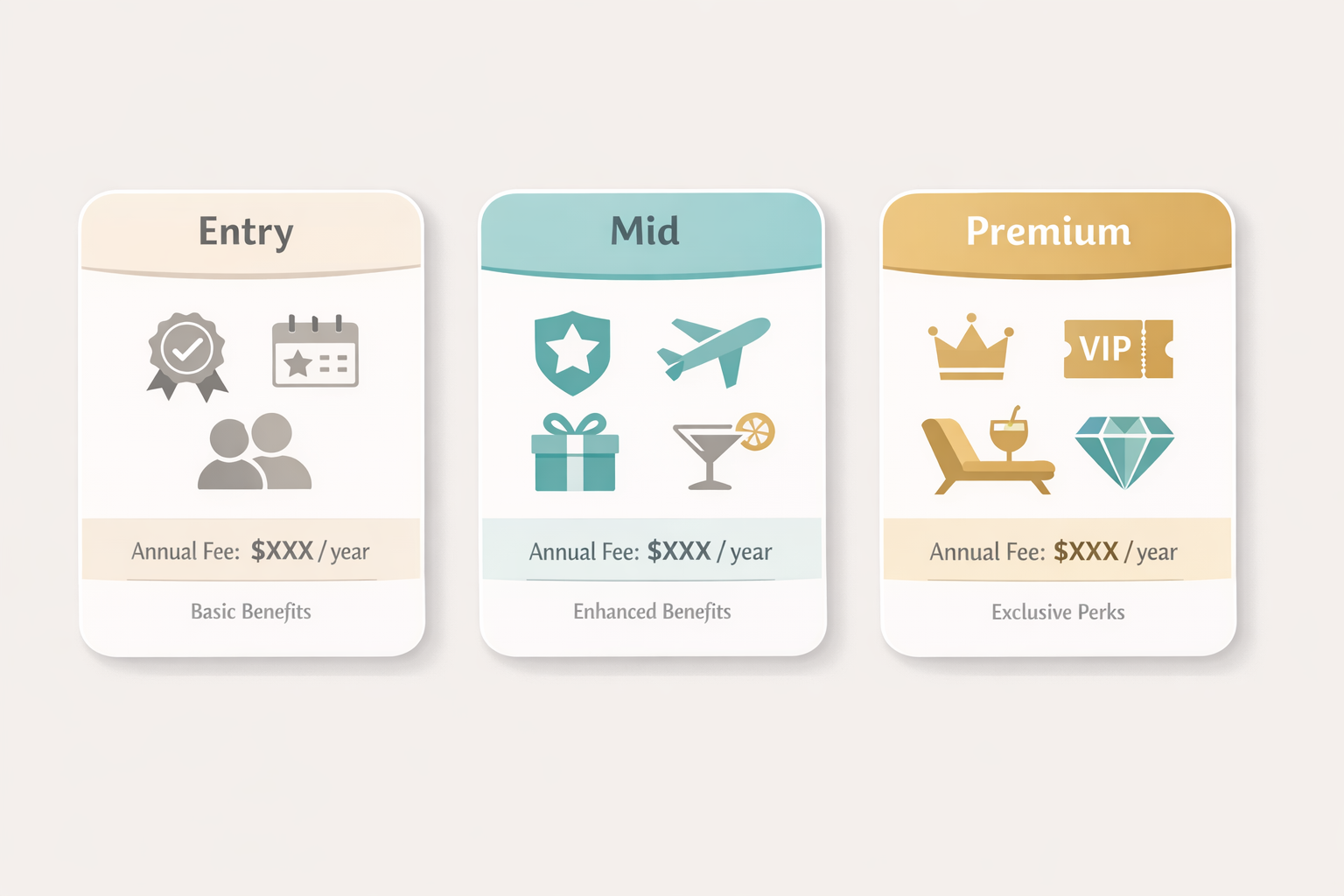
Example membership tier structure displaying entry, mid, and premium levels with associated benefits, access privileges, and annual fee structures designed for premium D2C brands.
D2C-Specific Challenges and Profitability Drivers
Many digitally native vertical brands (DNVBs) face stalled growth, rising acquisition costs, and persistent profitability challenges as ecommerce growth normalizes and D2C shifts from growth engine to strategic channel[27]. Subscription models address these headwinds by shifting the revenue model from transactional to relational, reducing dependence on continuous acquisition spend.
Customer acquisition cost to annual recurring revenue ratio for SaaS now stands at $2.00 to acquire $1.00 of new ARR, a 14% increase from 2023, elevating the importance of retention economics[28]. While this metric originates outside D2C, the underlying economics apply: when acquisition becomes more expensive, retention becomes more valuable.
Traffic from AI-driven sources to brand sites surged 1,200% between July 2024 and February 2025, signaling that D2C sites must become AI-ready storefronts with structured data and rich product descriptions[29]. This shift in discovery behavior reinforces the value of owned subscriber relationships that bypass algorithm-dependent traffic sources.
Costco's net sales in Q1 2026 reached $66 billion with a revenue CAGR of 9.3% over five years with no down years, demonstrating resilience and the value of membership-based business models[30]. The membership model provides revenue stability that insulates against economic volatility and competitive pressure.
Practical Considerations for Implementation
When evaluating subscription infrastructure, consider both immediate implementation costs and long-term scaling economics. Transaction-based pricing models can appear attractive at launch but may erode margin contribution as volume grows. Fixed-fee platforms with inclusive retention features can deliver better unit economics for brands processing substantial recurring order volume.
For luxury brands, subscription tier design should emphasize exclusivity, concierge fulfillment, and personalized packaging rather than discount-driven value propositions. Mid-market brands can focus on convenience, predictable delivery, and clear value through bundling or preferential pricing. The tier structure should align with brand positioning while creating clear upgrade incentives.
Payment recovery infrastructure deserves dedicated attention, given that involuntary churn represents recoverable revenue. Implementing card updater services and intelligent retry logic can recapture a substantial portion of failed transactions without requiring manual intervention or customer outreach.
Engagement between purchase cycles appears to be associated with retention performance. Consider how subscribers interact with brand content, member portals, or exclusive communications during periods when they are not actively purchasing. These touchpoints can maintain relationship strength and reduce voluntary churn.
Subscription and membership models represent a structural opportunity for premium D2C brands to stabilize cash flow, increase customer lifetime value, and reduce dependence on acquisition-driven growth. The research indicates that properly designed subscription programs deliver measurable improvements in retention, spending behavior, and revenue predictability. Implementation requires careful consideration of technology economics, tier structure, payment infrastructure, and ongoing engagement strategies. For brands operating at strong margins with established customer bases, subscription models can transform unit economics while deepening competitive defensibility. What aspect of subscription infrastructure presents the greatest implementation challenge for your brand—technology selection, tier design, or operational fulfillment?
SUBMIT YOUR COMMENT