

Blanket discounts erode margins by 12-18%. Smart pricing strategy with targeted incentives and bundles increases conversion 15-25% while protecting AOV. Retailers face constant pressure to discount, yet sitewide promotions train customers to wait for sales and devalue full-price inventory. The alternative lies in adaptive pricing tactics that respond to customer behavior, purchase context, and product mix. These approaches preserve brand equity while delivering the conversion lift that businesses need.
The Hidden Cost of Blanket Discounts
Brands that frequently run sitewide promotions see their average order value drop by 12–18% [1]. This erosion compounds over time as customers learn to anticipate sales cycles and delay purchases. The margin impact extends beyond the immediate discount; it reshapes customer expectations and purchasing behavior across the entire catalog.
Customers acquired during promotional periods have 23% lower repeat purchase rates at full price [1]. This pattern creates a cycle where brands must continuously discount to maintain volume, further degrading margins. The long-term effect is a customer base conditioned to transact only during sales events, making it difficult to sustain profitability on standard pricing.
Tactic One: Strategic Product Bundling
Brands implementing product bundles see 20% sales increases and 30% profit gains [2]. Bundling shifts the value conversation from price reduction to enhanced utility, allowing retailers to maintain margin while increasing perceived value. The profit advantage stems from moving multiple units per transaction without the margin sacrifice inherent in percentage-off discounts.
Most businesses achieve 20–30% AOV improvements with well-designed bundle strategies [2]. This lift occurs because bundles encourage customers to purchase complementary items they might not have considered individually. The AOV increase directly translates to higher revenue per customer interaction, improving unit economics without altering the underlying cost structure.
Strategic bundling improves conversion rates by 15–25% [2]. Bundles reduce decision friction by presenting a curated selection, which accelerates the path to purchase. This conversion advantage is particularly valuable for mid-market brands seeking to compete on value proposition rather than price alone.
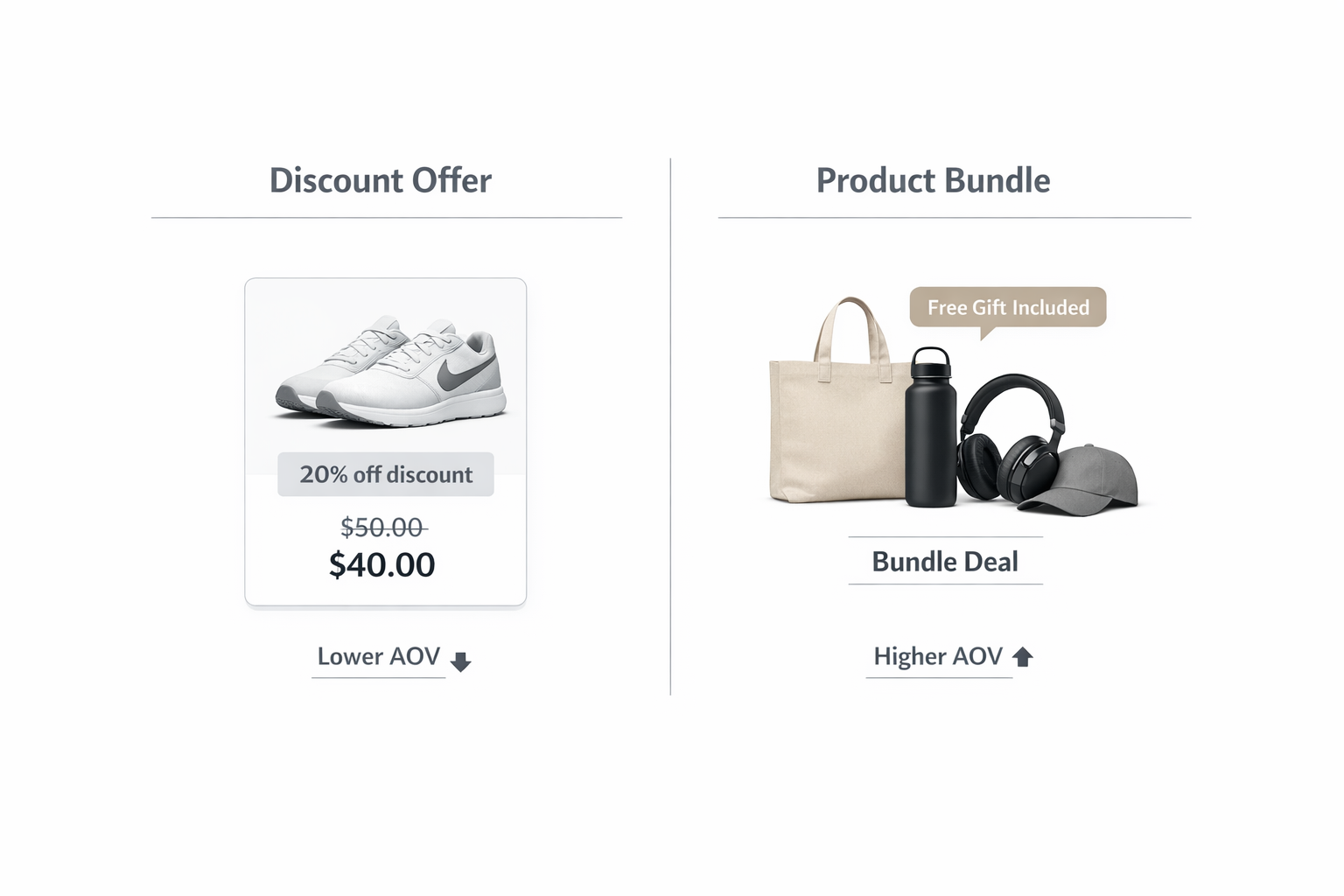
Comparison of discount versus bundle pricing structures and their impact on average order value
Margin-Aware Bundle Construction
Analyze margin structures across your catalog; effective bundles often pair high-margin products with lower-margin items to maintain healthy overall bundle profitability while offering compelling customer value [3]. This approach protects total margin dollars per transaction even when individual items carry different contribution levels. The key is ensuring the weighted average margin of the bundle exceeds your minimum threshold.
Most successful bundles offer 15–25% savings compared to individual purchase prices [3]. This range provides meaningful savings without excessive margin sacrifice. Calculate the discount as a percentage of the sum of individual item prices, then verify that your realized margin per bundle still meets profitability targets.
Optimal bundle size typically ranges from 2–5 items; two-item bundles are easy to understand, while three to four items hit the sweet spot for most categories—enough variety to feel substantial but not overwhelming [3]. Larger bundles risk decision paralysis and logistical complexity. Test bundle sizes within this range to identify the configuration that maximizes both conversion and margin for your specific product mix.
Price anchoring through tiered bundles works by presenting the most expensive option first; place your premium bundle at the top of the visual hierarchy to establish this anchor effect [3]. This positioning makes mid-tier bundles appear more accessible by comparison, increasing their selection rate. The anchor bundle need not be the best seller; its role is to frame the value of other options.
Tactic Two: Buy-One-Get-One and Free-Gift Incentives
Shoppers are willing to spend 40% more when they see "Buy One, Get One Free" [4]. The framing of receiving an additional item at no cost creates stronger perceived value than an equivalent percentage discount. This psychological effect drives higher transaction sizes because customers focus on the gain rather than the expenditure.
AOV-gated free gifts often outperform percentage-off discounts by creating higher perceived value, encouraging larger purchases, and providing a more tangible reward that feels like a bonus rather than a reduction [5]. Free gifts also allow brands to move inventory strategically, pairing high-margin anchor products with complementary items that have lower costs but high perceived value. The gift serves as both an incentive and a product discovery mechanism.
BOGO and Free-Gift Execution
The most successful BOGO (Buy One, Get One) campaigns pair high-margin anchor products with complementary items that have lower costs but high perceived value [4]. Identify products in your catalog where the cost of goods sold is significantly below retail price, then use these as the "free" component. This structure protects your margin on the anchor item while delivering a compelling offer.
For luxury brands, use customer segmentation to tailor offers; send VIP customers exclusive early access to sales, while offering first-time buyers a "gift-with-purchase" that introduces them to the brand’s luxury standard without a steep price drop. This segmentation prevents broad discounting while still providing targeted incentives where they drive the most incremental value. Define clear criteria for each segment—purchase history, lifetime value, engagement level—and assign offer types accordingly.
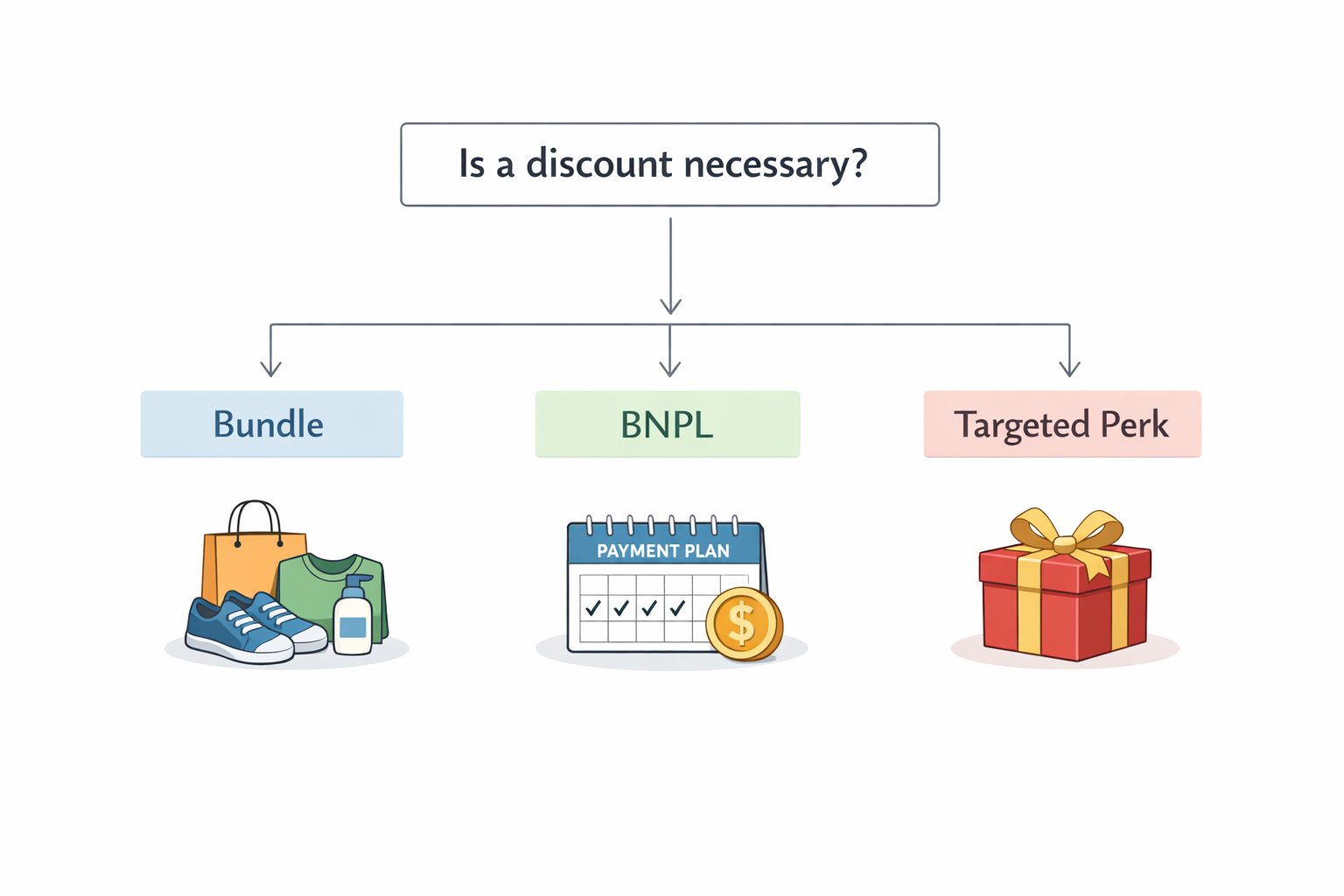
Decision framework for selecting the appropriate pricing tactic based on customer behavior and purchase context
Tactic Three: Flexible Payment Options
BNPL increases e-commerce conversion rates by 20–30% [6]. Payment flexibility removes the immediate cash flow barrier for higher-ticket purchases, allowing customers to commit to transactions they might otherwise defer. This conversion lift occurs without reducing the nominal price, preserving both margin and brand positioning.
Offering BNPL lifts average order value by 30–50% [6]. Customers who use installment payment options tend to purchase more expensive items or add additional products to their cart, knowing the payment will be spread over time. This AOV expansion directly improves revenue per transaction without the margin erosion associated with discounts.
BNPL adoption can cut cart abandonment by up to 35% [6]. Many customers abandon carts due to sticker shock or cash flow concerns; installment options address both objections. The reduction in abandonment translates to recovered revenue that would otherwise be lost, making BNPL a powerful tool for improving funnel efficiency.
Implementing Targeted Incentives
Gradually replace sitewide discounts with targeted offers for visitors showing exit intent or at specific conversion points [7]. Use personalized, single-use coupon codes and timers for abandoners. Segment your traffic—VIP versus new—and define offer rules for each group, such as discount amount, expiration, gift incentives, and product exclusions. This targeted approach ensures incentives reach only those customers who need them to convert.
Calculate the margin lost to blanket discounts to justify targeted trial [7]. Multiply your average discount percentage by total discounted revenue, then compare this figure to the margin you would retain under a targeted approach. This calculation provides the business case for shifting resources toward behavior-based incentives.
Run a 30-day A/B pilot on a sample of visitors comparing blanket versus targeted incentives; measure gross profit, not just revenue [7]. If targeted beats blanket on gross profit, scale to 100% of traffic. Track conversion rate, AOV, and margin per order for each cohort. The test duration allows you to capture repeat purchase behavior and assess whether targeted offers improve customer quality over time.
- Pair high-margin products with lower-margin items in bundles to maintain overall profitability
- Offer bundles with 15–25% savings compared to individual item prices
- Use BOGO campaigns that pair high-margin anchors with complementary items of high perceived value
- Segment traffic by VIP status and purchase history, then assign offer rules for each group
- Run 30-day A/B tests comparing blanket versus targeted incentives, measuring gross profit as the primary metric
Conclusion
Adaptive pricing tactics shift the value conversation from price reduction to enhanced utility and payment flexibility. Bundling, free-gift incentives, and installment options each address different customer objections while protecting margin and brand positioning. The transition from blanket discounts to targeted offers requires testing and segmentation, but the margin improvement and customer quality gains justify the operational investment. What pricing tactic will you test first to protect your margins while maintaining conversion momentum?



SUBMIT YOUR COMMENT